
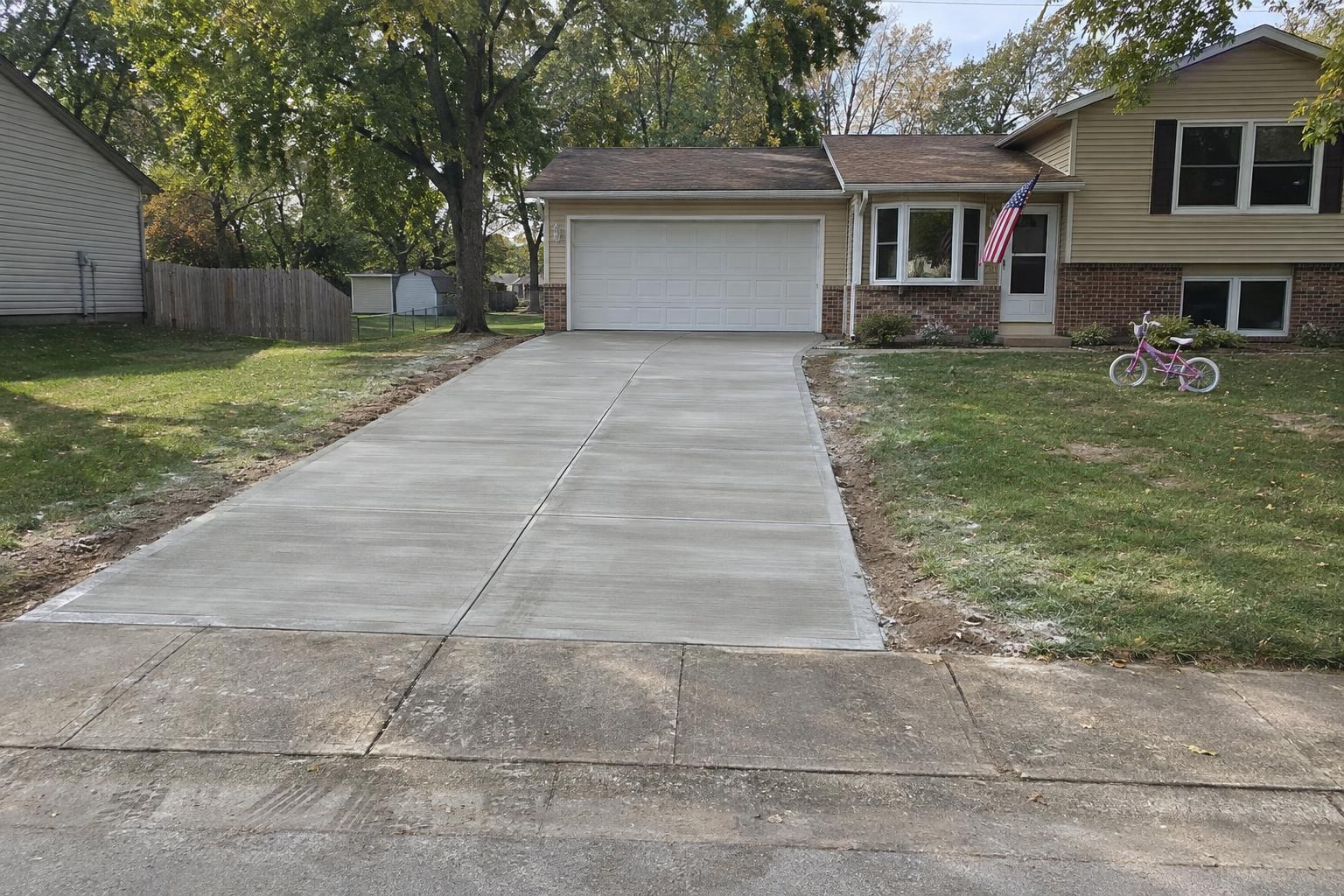
Concrete looks the same in every driveway photo. A flat gray slab doesn't tell you what's underneath it, and that's exactly where most of the mistakes happen. In St. Joseph County, what's underneath matters more than most homeowners realize, because our clay soil and our winters don't forgive shortcuts the way sandier, milder places do.
This isn't a pitch for one service over another. Whether you're pouring a driveway, a patio, a shop floor, or putting in footings for an addition, the same questions separate a contractor who knows this ground from one who's just good at smoothing a surface.
Why South Bend soil changes the job
Most of this area sits on heavy clay, sometimes with pockets of sand and glacial till left behind from the last ice age. Clay holds water. When it's wet it swells, and when it dries out in August it shrinks and pulls away from whatever's sitting on it. That movement is what cracks slabs that weren't prepped right, not the concrete itself failing.
A contractor who knows the area will tell you how much base material they're putting down before they pour, and it should be compacted crushed stone, typically 4 to 6 inches for a driveway or patio, not just dirt graded flat. Skip that step and you're building on the same clay that's going to heave come spring thaw.
Footings are a different story. Our frost line runs around 32 to 36 inches depending on the winter, and any footing for a foundation, a porch, or an attached structure needs to sit below that or it'll lift with the frost. Ask where the footing depth is coming from, the county building code or a guess.
What a real quote looks like
A quote scratched on the back of a business card isn't a quote, it's a guess with a dollar sign on it. You want to see the thickness of the slab in inches, whether it's 4 inches for a sidewalk or 5 to 6 for a driveway that'll see a truck, what's reinforcing it, and what the base prep involves.
On reinforcement, ask rebar or wire mesh. Mesh has its place, but it tends to sit at the bottom of the pour unless somebody's chairing it up during the work, and concrete only resists compression well, not tension, so steel placement actually matters. For driveways and anything that'll carry vehicle weight, rebar on chairs, spaced correctly, holds up better long term than mesh that ended up buried at the bottom of the slab.
Ask about control joints too. These are the cut lines you see in a driveway or sidewalk, and they should go in within 24 to 48 hours of the pour, cut to about a quarter of the slab's depth. They're there to tell the concrete where to crack as it shrinks during curing. Skip them, or cut them too late, and the slab picks its own crack line, usually somewhere you didn't want one.
Questions worth asking before anyone signs anything
- How many days before I can walk on it, drive on it, or put a stamped pattern down? A driveway generally needs 5 to 7 days before light foot traffic is fine and closer to a full week before you park a car on it, longer if it's cold.
- What happens if it rains the week of the pour? Spring here is unpredictable, and a contractor who's done this a while has a plan for rescheduling or protecting a fresh pour, not just hoping the forecast holds.
- Do they pull a permit, or do you have to? Footings and foundation work almost always need one, and plenty of flatwork does too depending on the township.
- Are they insured for the work, and will they put that in writing?
- What's the warranty on cracking, and does it cover settling cracks or just workmanship defects?
Signs to walk away from
A price that's dramatically lower than every other bid usually means something's getting cut, and it's almost always the base prep or the reinforcement, because those are the parts you can't see once the concrete's down.
No written contract. A handshake and a Venmo request isn't how this trade should work, full stop.
Nobody can tell you the mix design or at least the strength, measured in PSI. A standard driveway mix around here should run 4,000 PSI or better to handle our freeze-thaw cycles, which number somewhere around 30 to 40 a year depending on the winter. A 3,000 PSI mix might be fine for a sidewalk, but it's not what you want under a truck in January.
Pressure to pour the same week you call, especially late in fall. Concrete needs time to cure before a hard freeze hits it, and pouring into late October or November around here is a gamble unless the contractor knows how to manage curing temperature with blankets or additives.
Permits, older neighborhoods, and what's already in the ground
If you're inside South Bend city limits, building and zoning work generally runs through the city; outside the city, in Granger, Osceola, or unincorporated parts of the county, it typically goes through St. Joseph County. Footings, foundations, and some larger flatwork usually need a permit and an inspection before the pour, not after. A contractor who's pulled permits here before knows which inspector wants to see the forms and rebar in place before concrete trucks show up, and which jobs need a setback check against your property line first.
Older neighborhoods near downtown, Riverside, and the areas close to Notre Dame were mostly built from the 1920s through the 1950s. That means old footings, mature tree roots that have had seventy years to find your sewer line or shift a sidewalk slab, and sometimes buried debris from a previous structure. Newer subdivisions out toward Granger and Mishawaka's edges sit on more consistent fill, which is easier to work with but still needs proper compaction, not just a bulldozer pass.
HOAs are common in some of the newer developments, and a few have specific rules about driveway finishes or even require stamped or exposed aggregate over plain broom finish. Worth checking before you pick a finish you love and then find out it's not allowed.
What this comes down to
None of this is complicated once you know what to ask. A contractor who answers these questions without hesitating has probably poured a hundred driveways that cracked the wrong way and learned from it. One who gets vague or annoyed by the questions is telling you something too.
We've handled driveways, patios, footings, and shop floors all over St. Joseph County, dealing with this same clay and these same winters. If you want to talk through what a job actually needs before you spend money on it, Stonecraft Concrete Solutions is a good place to start.